Introduction
A truck wrap can change your vehicle's color, shield the factory paint, or turn a work truck into a rolling billboard. What most buyers struggle with is the quote: prices swing widely, and it's hard to tell what you're actually paying for.
Current U.S. installer estimates for 2025 show real spread: professional wraps range from roughly $1,100 for basic decals to over $7,000 for full commercial fleet graphics, according to VehicleWrapping.com's 2025 pricing guide. Truck size, coverage, vinyl grade, design, and labor all move that number.
This guide breaks down current pricing ranges, the factors that push costs up or down, and what a solid quote should include.
You’ll leave with a clear budget range—whether you’re wrapping one truck or rebranding a fleet.
Key Takeaways
- Basic decals and lettering typically run $1,100-$1,700; partial wraps land between $1,000-$3,675
- Full pickup and commercial wraps range from $3,000 to over $7,000 depending on vehicle size and finish
- Most price gaps come from surface area, coverage level, vinyl quality, design complexity, and labor
- Small vehicles and simple graphics stay at the low end; large trucks with premium film and full branding hit the high end
- The lowest bid isn't automatically the best deal. Compare materials, prep work, and warranty coverage before you decide
How Much Does a Truck Wrap Cost? (Pricing Overview)
There's no fixed national price for a truck wrap. The ranges below are current U.S. estimates cross-checked with multiple professional installers, not a single national average.
Misreading these ranges causes real budget problems. Common mistakes include:
- Comparing a material-only quote to a fully installed price from another shop
- Assuming design work is bundled in when it's often billed separately
- Approving a project without asking about repair, removal, or travel fees upfront
Typical Cost Ranges
| Project Type | Typical Cost Range | Usually Includes | Best For |
|---|---|---|---|
| Decals/cut lettering | $1,100-$1,700 | Design, printing, install | Logos, phone numbers, simple branding |
| Partial or half wrap | $1,000-$3,675 | Vinyl for select panels, install | Budget-conscious branding, accent graphics |
| Full pickup wrap | $3,150-$7,115 | Full exterior coverage, install | Color change, full brand takeover |
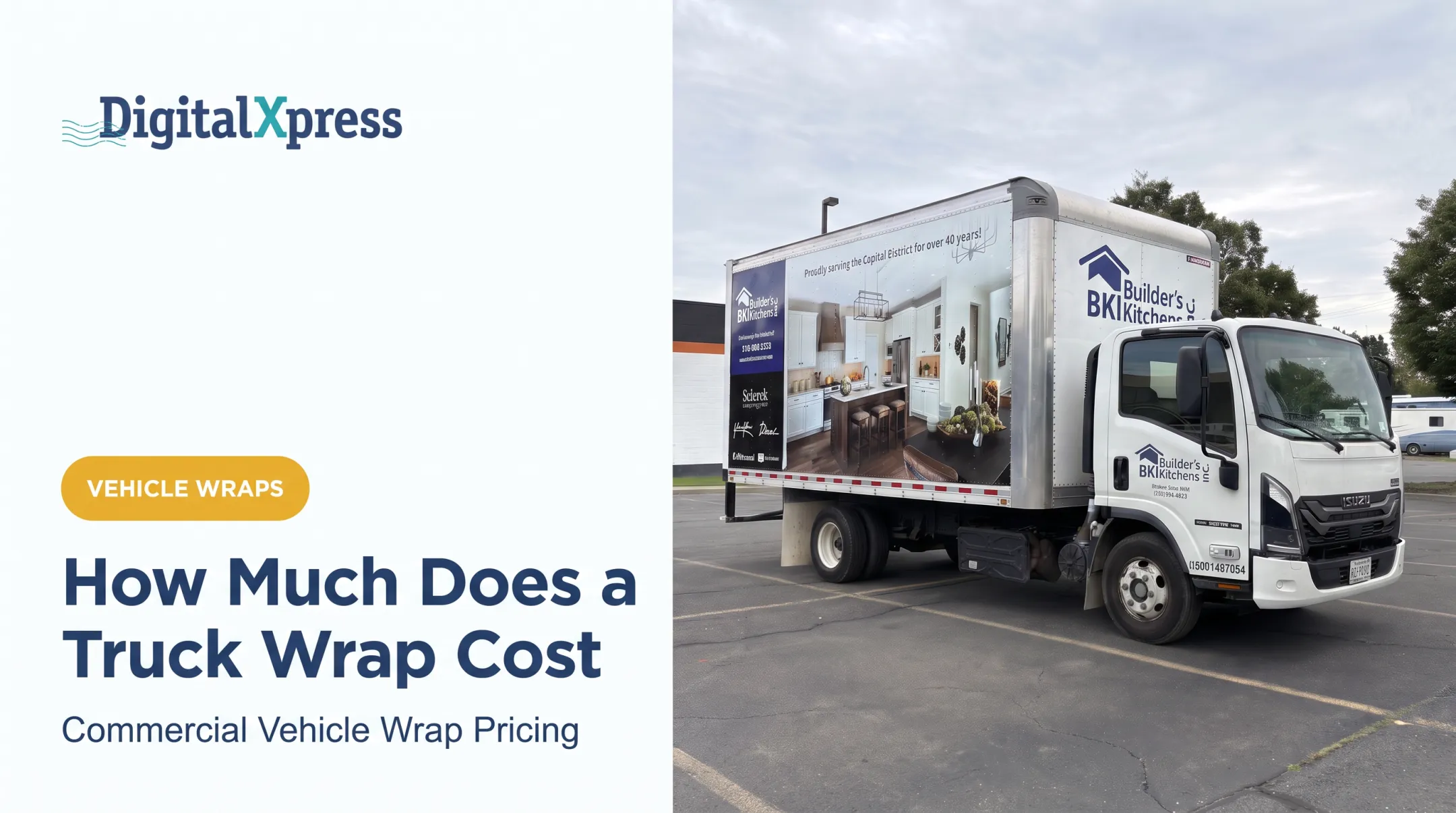
| Box truck/fleet graphics | $3,500-$7,500+ | Custom design, large format printing, install | High-visibility mobile advertising |
| Installation only | $1,875-$3,250 | Labor only, no design or printing | Businesses supplying their own printed vinyl |
Source: VehicleWrapping.com, 2025; Metro Restyling, 2025
Most quotes exclude sales tax, roof and bumper coverage (often an upgrade), old-wrap removal, and repair of pre-existing paint damage. Always ask what's excluded, not just what's included.
Wrap style is the other big swing factor once you know what’s in the quote. A standard color-change wrap uses solid vinyl with no printing, so it’s usually simpler and cheaper. A printed business-branding wrap needs photographic graphics, logo placement, contact details, and often design revisions. That extra production work raises cost beyond the vinyl itself.

Key Factors That Affect Truck Wrap Cost
Pricing comes down to a combination of material quantity, vehicle shape, creative work, and the labor required to install everything cleanly.
Truck Size, Model, and Body Shape
Bigger trucks need more vinyl and more install time, plain and simple. A Toyota Tacoma typically requires 55-65 feet of vinyl, a Ford F-150 needs 65-75 feet, and a heavy-duty Super Duty can require up to 85 feet, according to Metro Restyling's 2025 pricing data.
Box trucks and food trucks add even more surface area.
Features that add difficulty and cost:
- Long beds and dual rear wheels
- Deep body lines, moldings, and rivets
- Mirrors, handles, ladder racks, and aftermarket accessories
- Dented, rusted, or previously wrapped panels
Coverage and Wrap Type
Lettering and spot graphics use the least material and take the least time. Half wraps and full wraps use significantly more square footage, and more edges mean more trimming, more waste, and longer install hours.
Before approving a quote, confirm whether it covers the roof, tailgate, bumpers, mirrors, door jambs, wheel arches, and windows. These areas are frequently excluded by default.
Vinyl Quality, Finish, and Lamination
Standard cast vehicle vinyl conforms better to curves, resists fading longer, and typically comes with a manufacturer warranty. Cheaper alternatives may look fine on delivery but can shrink, discolor, or lift within a year or two.
Specialty finishes cost more because they demand more careful handling:
- Chrome and metallic films
- Satin and matte finishes
- Textured or color-shifting vinyl
- Reflective safety film
Design and Customization
Original artwork, photo-heavy graphics, multiple color layers, and precise panel-to-panel alignment all add design and production time.
For commercial trucks, readable branding with a clear phone number and strong contrast usually delivers more return than an intricate design that's hard to read at highway speed.
Installation, Preparation, and Local Labor
A typical install covers prep, application, and finishing:
- Clean and degrease the surface
- Remove hardware when needed and fix minor surface issues
- Apply and post-heat the vinyl
- Trim edges and inspect the finished job
Installer experience, regional labor rates, facility vs. on-site work, and warranty coverage all affect the final price. Installation labor alone typically runs $1,875-$3,250 based on vehicle complexity.

Cost Breakdown: What a Truck-Wrap Quote May Include
An advertised wrap price often bundles several distinct services. Ask for an itemized breakdown before signing off.
Typical line items include:
- Design and artwork — Template setup, logo work, concept development, revision rounds, production-ready files, and artwork ownership or reuse rights
- Materials and printing — Vinyl, ink, laminate, color-matching, test prints, and extra material for complex body panels without visible seams
- Installation and preparation — Cleaning, hardware disassembly and reassembly, minor surface repair, application labor, post-heating, edge finishing, and final quality inspection
- Recurring or later costs — Cleaning supplies, impact or peel repairs, eventual removal, replacement panels, rebranding, and graphics for future fleet vehicles
At Digital XPress, we handle vehicle wraps from initial design through printing and professional installation, using in-house wide-format printers and laminators. For businesses managing multiple trucks, design and production under one roof keeps graphics consistent across the fleet.
Before approving any quote, run through this checklist:
- Scope — Which panels, exactly, are covered?
- Timeline — When will design proofs and final installation be ready?
- Warranty — What's covered, and for how long?
- Payment terms — Deposit required? Balance due when?
- Tax, travel, and storage fees — Are these itemized or hidden?
- Pre-existing damage — Who's responsible if paint issues surface during install?
Low-Cost vs High-Cost Truck Wraps — What's the Difference?
Price alone doesn’t tell you much. The real gap between quotes is usually coverage, materials, and which services are included.
Performance and Appearance
Lower-cost quotes often include:
- Partial coverage instead of a full wrap
- Standard finish and fewer design elements
- Less complex print and layout work
That’s enough for many projects. Still, get material specs and warranty terms in writing before treating a low bid as equal to a premium one.
Higher-cost quotes typically reflect:
- Premium cast film and custom photographic printing
- Careful panel alignment across doors, rivets, and curves
- A more experienced installation crew
That mix usually yields cleaner seams and a more consistent finish.
Durability, Maintenance, and Long-Term Value
Those same material and install choices also drive how long the wrap holds up. Paying more usually makes sense when:
- The truck runs daily routes and takes constant sun and road exposure
- It represents a fleet or an established brand for several years
- The body has difficult geometry that needs careful, experienced installation
A cheaper wrap can still be the right call for a short-term promotion or limited graphics—if the quote spells out materials, coverage, and expected service life. Don’t assume a bargain wrap will match premium performance over three or four years.
How to Estimate the Right Truck-Wrap Budget
Getting an accurate budget starts before you request a single quote.
- Define the goal. Are you after a color change, paint protection, lead generation, a temporary promotion, or fleet consistency? The goal shapes everything downstream.
- Document the vehicle. Capture make, model, year, cab and bed configuration, accessories, current paint condition, and the exact panels to wrap.
- Set design requirements. Decide between lettering, a partial graphic, or a full printed wrap, and specify brand guidelines, finish, and how many revision rounds you'll allow.
- Request itemized, comparable quotes. Ask each provider to price the identical scope. Compare vinyl brand, laminate, prep work, installation, warranty, and turnaround, not just the bottom-line number.
- Plan for the full lifecycle. Factor in cleaning, repairs, eventual removal or rebranding, and repeat artwork for additional trucks as the fleet grows.

If you plan to extend the same branding across several vehicles, build design support into the budget. Our in-house creative team handles logo development and large format design that can carry across a growing fleet.
Finally, weigh the cost against business value:
- Intended service life
- How often the truck is on the road
- Visibility in your market
- Comparison to a paint job or another advertising channel over the same period
What Most People Miss When It Comes to Truck-Wrap Cost
Buyers who focus only on the headline price often get surprised later. Watch for these blind spots:
- Hidden line items — design revisions, surface repairs, disassembly, hard-to-reach panels, travel charges, sales tax, removal, and replacement panels
- Vehicle condition — peeling paint, rust, body filler, dents, or an old wrap underneath can affect adhesion or rule out certain surfaces entirely
- Fleet consistency — plan ahead for readable contact details, regulatory markings, and how artwork will adapt across different truck models as you add vehicles
- Maintenance habits — hand-wash or use touchless cleaning every two weeks per Avery Dennison's guidance; avoid abrasive brushes, harsh chemicals, and high-pressure spray near edges unless your installer approves
Conclusion
Truck-wrap pricing swings based on vehicle size, coverage, material, design complexity, prep work, and how the job gets installed. There's no shortcut around requesting a real quote.
A useful budget keeps design, materials, installation, maintenance, and eventual removal or replacement as separate line items, not one lump figure. That's the only way to compare bids fairly.
Request an itemized quote from an experienced provider, and pick the option that balances appearance, durability, and total cost over the wrap's full lifespan, not just the number on page one.
Frequently Asked Questions
Can a wrapped truck go through a carwash?
Hand washing or an installer-approved touchless wash is safest. Avoid automatic brushes and high-pressure spray on edges, and follow the film maker's and installer's care guide.
How much does it cost to wrap a truck?
Cost depends on size, coverage, material, design, prep, and install. U.S. prices often run about $1,100 for decals to over $7,000 for full commercial wraps—ask for an itemized quote.
Is a partial truck wrap cheaper than a full wrap?
Yes—partial coverage usually means less vinyl and less labor. Complex panels or detailed design work can still bring a partial job close to a simpler full wrap.
How long does a professional truck wrap last?
Service life depends on the specific film, climate, sun exposure, vehicle use, and installation quality, so check the manufacturer's warranty for your chosen film. Regular cleaning and proper storage help maximize that lifespan.
Will a truck wrap damage the original paint?
Professionally installed and removed vinyl is meant to protect sound factory paint. Damaged, repainted, oxidized, or poorly cured surfaces raise adhesion and removal risks.
Can I wrap a truck myself to save money?
DIY can cut labor cost if you have the right film, tools, space, and skill—and budget for waste. For large, complex, or business-critical graphics, hire a pro.