Introduction
The size and shape of a direct mail piece decides more than how it looks in a mailbox. It sets your available message space, drives production requirements, and determines which USPS mail class and postage rate your piece actually qualifies for.
Get it wrong, and you could end up redesigning mid-campaign or paying letter-size postage on something you budgeted as a postcard. Thickness, weight, shape, folds, and finishing all affect mailability, not just length and width.
This guide covers the standard direct mail formats: postcards, letters, self-mailers, flats, catalogs, and EDDM pieces. You'll also learn how USPS classification works, how size drives postage, and how to choose and preflight the right format before you print.
Key Takeaways
- Size is only part of the equation: thickness, weight, shape, folds, and prep all affect mailability and postage
- Verify USPS requirements for postcards, letters, flats, and EDDM before finalizing artwork
- Match format to message: simple offers suit postcards; detailed content needs letters, self-mailers, or catalogs
- Larger pieces aren't automatically better; they add production complexity, postage, and handling costs
- Test format, message, audience, and offer together instead of assuming the largest size wins
What Direct Mail Sizes Represent in USPS Mail Classes
Direct mail size refers to a piece's physical construction: length, height, thickness, orientation, folds, and overall shape. That's a separate question from mail class: the postage service, such as First-Class Mail, USPS Marketing Mail, or EDDM, that actually carries the piece.
A postcard, letter, or flat is a physical format, not a mail class. The same physical dimensions can move through different postage services depending on preparation and eligibility.
Here's where a lot of mailers get tripped up: "jumbo postcard" is a marketing term, not a USPS category. A 6x9 postcard is a popular commercial size, but USPS card pricing tops out at 6 inches long. Anything bigger gets evaluated as a letter or flat instead.
Current physical standards to check before production:
| Format | Minimum | Maximum | Thickness |
|---|---|---|---|
| Postcard (card pricing) | 3.5" x 5" | 4.25" x 6" | 0.007"–0.016" |
| Letter | 3.5" x 5" | 6.125" x 11.5" | 0.007"–0.25" (0.009" min over 4.25" x 6") |
| Flat | 6" x 5" | 12" x 15" | up to 0.75" |
USPS evaluates the finished, assembled mailpiece (envelope, inserts, tabs, folds, and coatings included), not just the flat printed sheet. A piece that measures correctly before folding can fail once sealed. Standards and pricing change regularly, so confirm current USPS letter and flat physical standards before locking artwork.
Common Direct Mail Sizes and Formats
Each format family serves a different job. Verify the dimensions below against current USPS rules before you commit to a live campaign.
Postcards
Compact postcards (3.5" x 5" up to 4.25" x 6") work well for:
- Short offers and appointment reminders
- Announcements with a single, clear call to action
- High-volume campaigns where cost per piece matters most
Larger postcards (5" x 7", 6" x 9", or 6" x 11") give more room for photography, testimonials, or event details. They're popular for promotions, fundraising appeals, and acquisition mailings.
The catch: once a "postcard" exceeds 6 inches long or 4.25 inches high, USPS treats it as a letter, not a card, which changes the applicable postage.
At Digital XPress, we print and mail roughly 700,000 postcards weekly across client campaigns. The sizing question comes up on nearly every job: bigger visibility versus simpler, cheaper production.
Letters and Envelope Packages
Standard business envelopes include the #10 (4.125" x 9.5"), the larger #14 (5" x 11.5"), and the A-10 (6" x 9.5"). Letters make sense when you need:
- Detailed explanations that won't fit on a postcard
- Transactional or account-related communication
- Fundraising appeals with a reply device
- Multiple inserts alongside the primary letter
Envelope dimensions, insert count, paper weight, and sealing method all affect processing speed and postage. A thicker package with three inserts behaves differently in the mail stream than a single folded sheet, even in the same envelope.
Self-Mailers
Bi-fold and tri-fold self-mailers add messaging space without the cost of a separate envelope. They fold flat, self-seal with tabs or glue, and run through USPS automation equipment when built correctly.
Key considerations:
- Fold placement affects how content reads once opened
- Tabbing or glue spots must meet USPS placement rules
- Address placement needs to clear barcode and automation zones
We run self-mailers on HP T250 web presses, which handle up to six miles of paper per hour. That throughput helps when a folded format needs to scale to a large mail file quickly.
Flats, Catalogs, and Booklets
Flats cover catalogs, magazines, booklets, newsletters, and any piece carrying more content than a folded self-mailer can hold. They're valuable when the offer requires a full product line, multiple pages, or reference material a recipient might keep.
The trade-off: flats carry different postage rates, must stay flexible and uniformly thick, and often add production steps like binding or stitching. We produce booklets on Heidelberg XL sheet-fed offset presses, where page count and binding method both factor into the finished thickness.
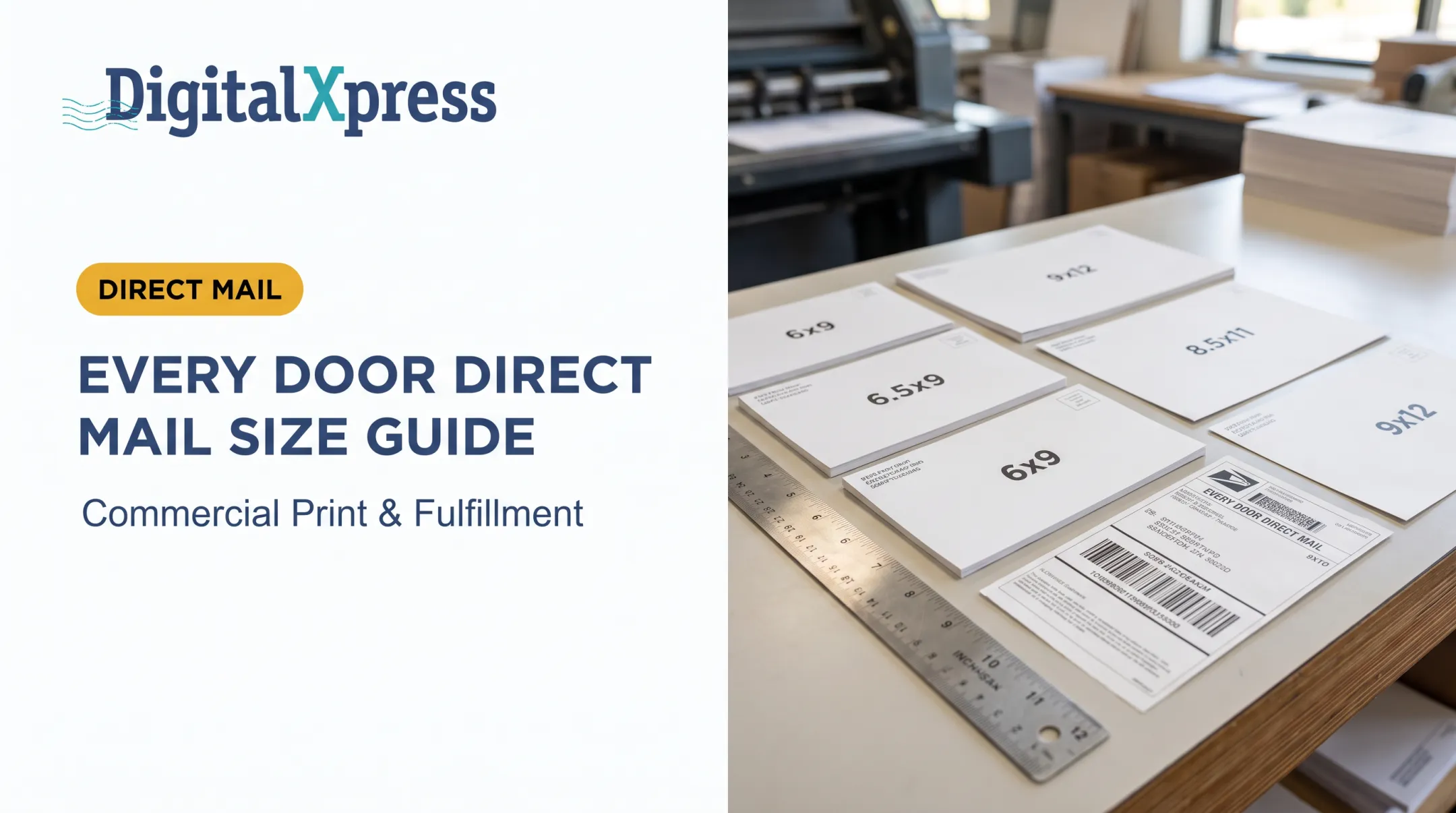
EDDM Mailpieces
Every Door Direct Mail is a route-based distribution method, not an addressed mailing list. Pieces go to every address on a carrier route rather than named recipients.
Current EDDM-Retail parameters include:
- Minimum 5" x 3.5" x 0.007"
- Must exceed at least one flat trigger: 10.5" long, 6.125" high, or 0.25" thick
- Maximum 15" x 12" x 0.75"
- Weight capped at 3.3 oz
Confirm current EDDM size, bundling, and preparation requirements directly with USPS before printing, since eligibility and bundling rules are specific to this product.

How Size Affects Postage and Mailability
Dimensions, thickness, weight, and shape determine mail class eligibility. Small changes can push a piece into a more expensive category.
A few boundaries matter most:
- Crossing 4.25" high, 6" long, or 0.016" thick removes First-Class card pricing
- Crossing letter maximums (6.125" x 11.5" x 0.25") pushes a piece into flat treatment
- A flat that isn't flexible or uniformly thick gets charged as a parcel, regardless of its length and height
This is why paper stock, coatings, inserts, folds, and tabs matter even when the printed dimensions stay the same. A thicker paper stock or an added insert can push a letter over its thickness threshold without anyone changing the trim size.
Automation compatibility adds another layer. Commercial letters and flats need clear space for postage, address, and barcode elements. On a letter-size piece, that lower-right zone sits roughly 4.75 inches from the right edge and 5/8 inch up from the bottom, per USPS mailing standards.
Rectangular construction and a consistent aspect ratio also decide whether a piece can run through automated equipment at all.
Keep postage separate from total campaign cost. Postage is one line item; production, list acquisition, creative, and fulfillment are others. For nonrectangular shapes, oversized pieces, thick stocks, or multi-component packages, confirm classification with USPS or your mailing provider using a physical sample, not just a spec sheet.

How to Choose and Prepare the Right Size
Start with the campaign objective and audience, not the size that looks most impressive on screen.
Match the Format to Message and Method
Compact postcards suit short, immediately visible messages. Larger postcards or self-mailers fit moderate content. Letter packages, booklets, or catalogs make sense when recipients need detailed information or multiple inserts.
Consider how much space your message actually requires:
- Call-to-action complexity
- Personalization and imagery
- Legal disclaimers or offer terms
- Reply mechanisms like a coupon or QR code
Address-based mailing and EDDM solve different problems. Address-based lists offer targeting precision, useful for known customers or a purchased prospect list. EDDM offers geographic saturation across every address on a route, which suits local businesses without a strong list.
Whichever you choose, the format has to remain compatible with the selected USPS service, your list strategy, preparation method, and delivery timeline.
Balance Visibility, Budget, and Production Complexity
A bigger piece stands out in the mailbox, but it also adds printing, paper, postage, and handling costs. That trade-off deserves a real test, not a guess.
Try testing two formats side by side while holding audience, offer, timing, creative, and call to action constant. Track response rate and cost per response. Don't assume the larger format wins without evidence.

Preflight the Mailpiece Before Printing
Before committing to a full print run, verify:
- Final dimensions, bleed, and trim (at least 0.125" bleed beyond trim edges)
- Folds, thickness, and paper stock weight
- Tabs, sealing method, and address placement
- Barcode clear zone, indicia, and required postal markings
- Personalization and variable data accuracy
Get a hard-copy proof or physical mock-up. Confirm the finished piece against current USPS documentation or with a mailing specialist before a large run goes to press.
For example, we coordinate creative development, in-house production, and mailing preparation under one roof, with an on-site USPS Postal Clerk reviewing mail before it ships. That support works alongside USPS approval, not in place of it.
Common mistakes to avoid:
- Assuming a commercially advertised size automatically qualifies for a specific USPS rate
- Measuring only the printed sheet while ignoring the finished folded, inserted, or sealed piece
- Designing first and checking postal requirements later, especially for EDDM or nonrectangular formats
- Relying on outdated USPS terminology, dimensions, or rates without checking the current source
- Choosing the biggest format without testing whether the extra space actually improves results
Conclusion
Direct mail size is a core specification. It shapes design, USPS classification, postage, production, and how the piece performs once it lands in the mailbox.
The right format depends on your message length, targeting method, audience, and budget. Verify current USPS rules before any piece goes to press. When a campaign needs one partner across creative, print, and mailing, we guide those choices from concept through delivery.
Frequently Asked Questions
How much does USPS direct mail cost?
Cost depends on format, dimensions, weight, thickness, mail class, quantity, and preparation method. Check current USPS pricing and get a project-specific estimate before budgeting a campaign.
What are the EDDM size requirements?
EDDM-Retail pieces generally run between 5" x 3.5" and 15" x 12", with a 3.3 oz weight limit and specific bundling rules. Confirm current requirements with USPS before printing, since eligibility details change.
Which postcard sizes qualify for USPS postcard rates?
Only pieces meeting current USPS card dimensions (roughly 3.5" x 5" up to 4.25" x 6"), thickness, and shape rules qualify for card pricing. Verify the finished piece rather than trusting a commercial size label.
What are the standard sizes for direct mail?
Standard categories include postcards, letters, self-mailers, flats, catalogs, booklets, and EDDM pieces. Each category carries different design, thickness, and postal requirements.
What are the different types of direct mail?
Common types include addressed postcards for quick offers, letters for detailed messaging, self-mailers for extra space without an envelope, catalogs or booklets for larger content, and EDDM for route-based saturation mailing.
What are common mistakes when using EDDM?
Frequent errors include incorrect dimensions or thickness, missing bundling steps, wrong route selection, and confusing EDDM with addressed mail. Always confirm current USPS EDDM rules before production.