Many agents struggle with a different problem: too many options, not enough time or budget. Should you invest in video? A new website? A postcard campaign? NAR's 2025 REALTOR Technology Survey found that 39% of leads come from social media, with brokerage websites, individual websites, and email marketing each contributing 11-13%. No single channel wins outright.
This guide breaks down which materials matter, when to use print versus digital, and how to build a system you can actually maintain instead of reinventing every campaign from scratch.
Key Takeaways
- A professional website, sharp property photos, and consistent contact materials are non-negotiable.
- Postcards, flyers, and signage still build local visibility and in-person trust.
- Connect every print piece to a trackable page with QR codes or short URLs.
- Reusable templates beat one-off designs for consistency and speed.
- Match materials to your goal and audience before choosing formats.
How to Choose the Right Real Estate Marketing Materials
Not every listing needs a printed brochure. Not every past client needs a postcard. The right material depends on what you're trying to accomplish and who you're trying to reach.
Start With the Goal, Then the Audience
Ask what this campaign is actually for:
- Winning a listing — presentation folders, market reports, past-sale proof
- Promoting a specific property — flyers, virtual tours, signage, social posts
- Nurturing past clients — newsletters, market updates, thank-you cards
- Generating referrals — client guides, closing gifts, follow-up emails
- Building neighborhood visibility — farming postcards, yard signs, door hangers
Once the goal is clear, define who's receiving the material:
- Buyers want visuals and logistics
- Sellers want proof you can market their home
- Past clients want to feel remembered, not sold to
- Referral partners and brokerage decision-makers respond to professionalism and consistency
Map Materials to the Client Journey
Materials work differently depending on where someone sits in the decision process:
- Awareness — yard signs, postcards, door hangers, social posts, local print ads
- Consideration — listing flyers, brochures, market reports, videos, floor plans, email newsletters
- Decision and relationship — presentation folders, buyer/seller guides, thank-you cards, follow-up sequences
A digital-only approach moves fast and costs less upfront but misses the physical memorability of print. Print-only campaigns build local trust but lack the reach and tracking of digital. Most successful agents run integrated campaigns: digital for reach and measurement, print for recall and local presence.
To build that mix without overspending, start with reusable branded essentials (logo, colors, templates), add listing-specific pieces as properties come on, then layer in recurring campaigns you can measure and refine over time.
Before anything goes to print, check brokerage branding guidelines, REALTOR® mark usage rules, Fair Housing language, image rights, and required disclosures. HUD's fair housing advertising rule prohibits discriminatory language, symbols, or imagery in any printed or published housing notice. Build those checks into every template so compliance is automatic, not a last-minute scramble.
Digital Real Estate Marketing Materials
Your website is the hub that everything else points back to. It needs current contact information, clear navigation, strong photography, and one obvious next step for visitors, whether that's scheduling a showing or requesting a home valuation.
Photography, Video, and Virtual Tours
Visual assets are essential. In NAR's 2024 Profile of Home Buyers and Sellers, 83% of buyers found photos very useful, while 60% valued virtual tours and 57% valued floor plans. Buyers' agents in NAR's 2025 staging report echoed this, prioritizing photos, video, and virtual tours as standard listing assets.

Treat these as a package:
- Professional photography (non-negotiable for any listing)
- A short walkthrough video for social and email
- An interactive floor plan for buyers comparing layouts
- A virtual tour for out-of-area or time-constrained buyers
Email, Social Media, and Advertising
Email remains one of the most cost-effective follow-up tools when it's segmented. Buyers, sellers, past clients, and referral partners each need different content, not the same monthly blast.
Real estate email benchmarks from Campaign Monitor show a 21.7% average open rate and 3.6% click-through rate for the industry. Treat those figures as a baseline to measure against, not a guarantee.
Social media often carries the heaviest lead-generation load for agents and teams. Keep a recurring content mix:
- New listing announcements
- Neighborhood insights and market updates
- Agent introductions and testimonials
- Behind-the-scenes content from showings or closings
Digital ads and landing pages work best when tied to one specific objective, one audience, and one call to action. A market report or virtual tour built for a listing page can double as email content or the destination for a print campaign, so the two channels reinforce each other instead of competing.
Print and Physical Marketing Materials
Digital gets the reach. Print sticks in people's hands—and their memory.
Research from Temple University, summarized by USPS, found physical ads created stronger, longer-lasting impressions and emotional response than digital across age groups. Digital led only on immediate attention.
Business Cards, Flyers, and Presentation Folders
These are the foundational relationship pieces:
- Business cards, letterhead, and stationery with readable contact info, a current headshot, consistent branding, and a QR code to your listings
- Property flyers and sell sheets for open houses and listing appointments
- Presentation folders for buyer consultations, luxury listings, and brokerage pitches
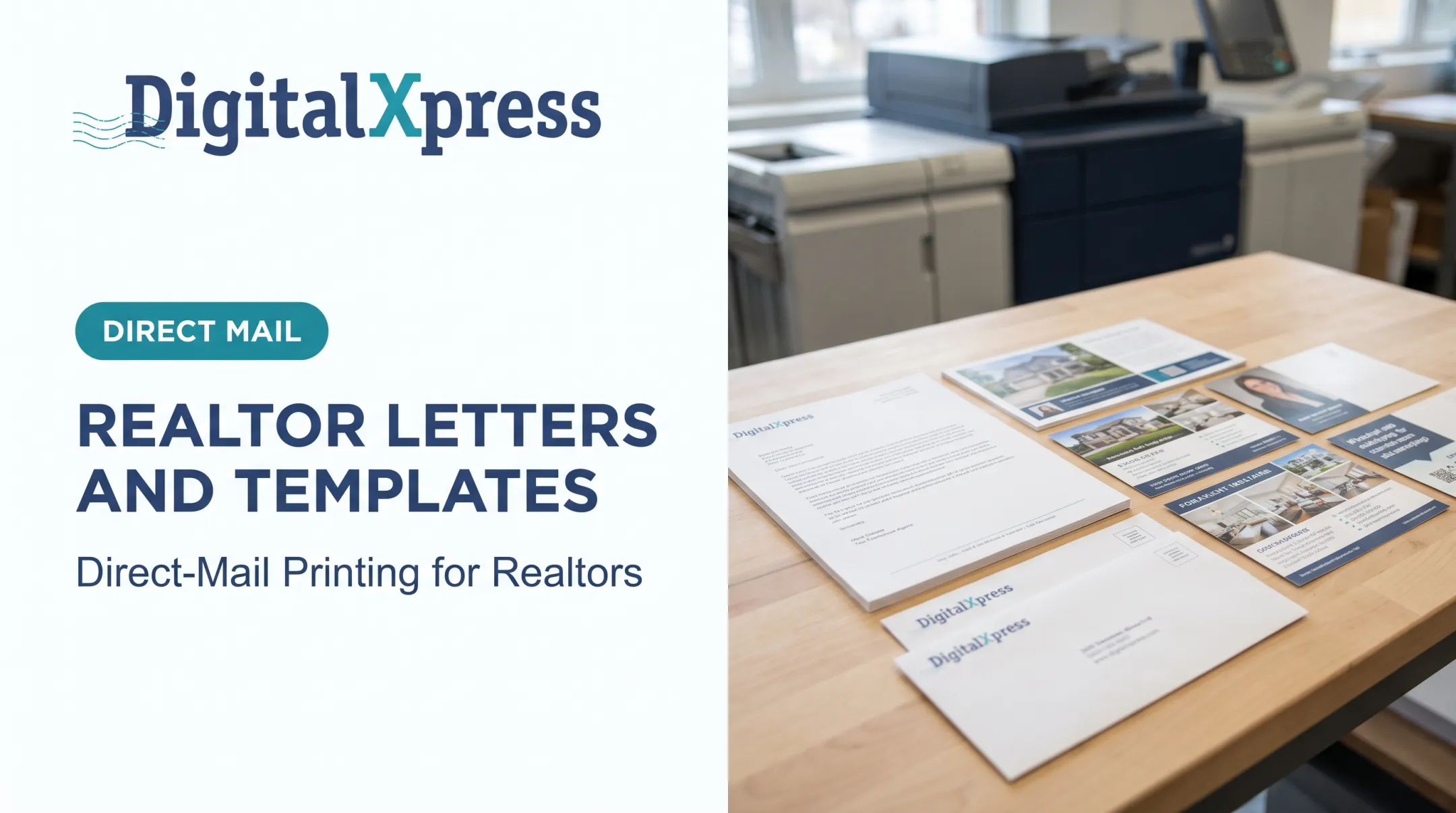
At Digital XPress, our HP Indigo presses handle short-run personalized pieces such as business cards and invitations. Trifold brochures and postcards typically ship in 5–7 business days from proof approval; complex finishing usually takes 7–14 days.

Direct Mail, Signage, and Retention Pieces
Direct mail earns its place in just-listed, just-sold, farming, and prospecting campaigns. Keep each piece audience-relevant and concise, and schedule drops consistently instead of sending sporadically.
Signage needs to work at a glance:
- Yard signs, riders, and directional signs that guide open-house traffic
- A-frames and banners for listing launches and community events
- Window graphics and development signage for multi-unit or new-construction projects
Legibility, weather-resistant materials, and consistent branding matter more than clever copy. We produce banners and lawn signs in vinyl, foam core, aluminum, and other durable materials, with custom sizing and in-house installation across the Capital Region.
Round out the system with thank-you cards, closing gifts, client guides, and neighborhood reports. These low-clutter pieces keep you top of mind for referrals without flooding a client's mailbox.
When a campaign needs coordinated design, variable data, multiple formats, or large-scale mailing prep, one print-and-mail partner saves time.
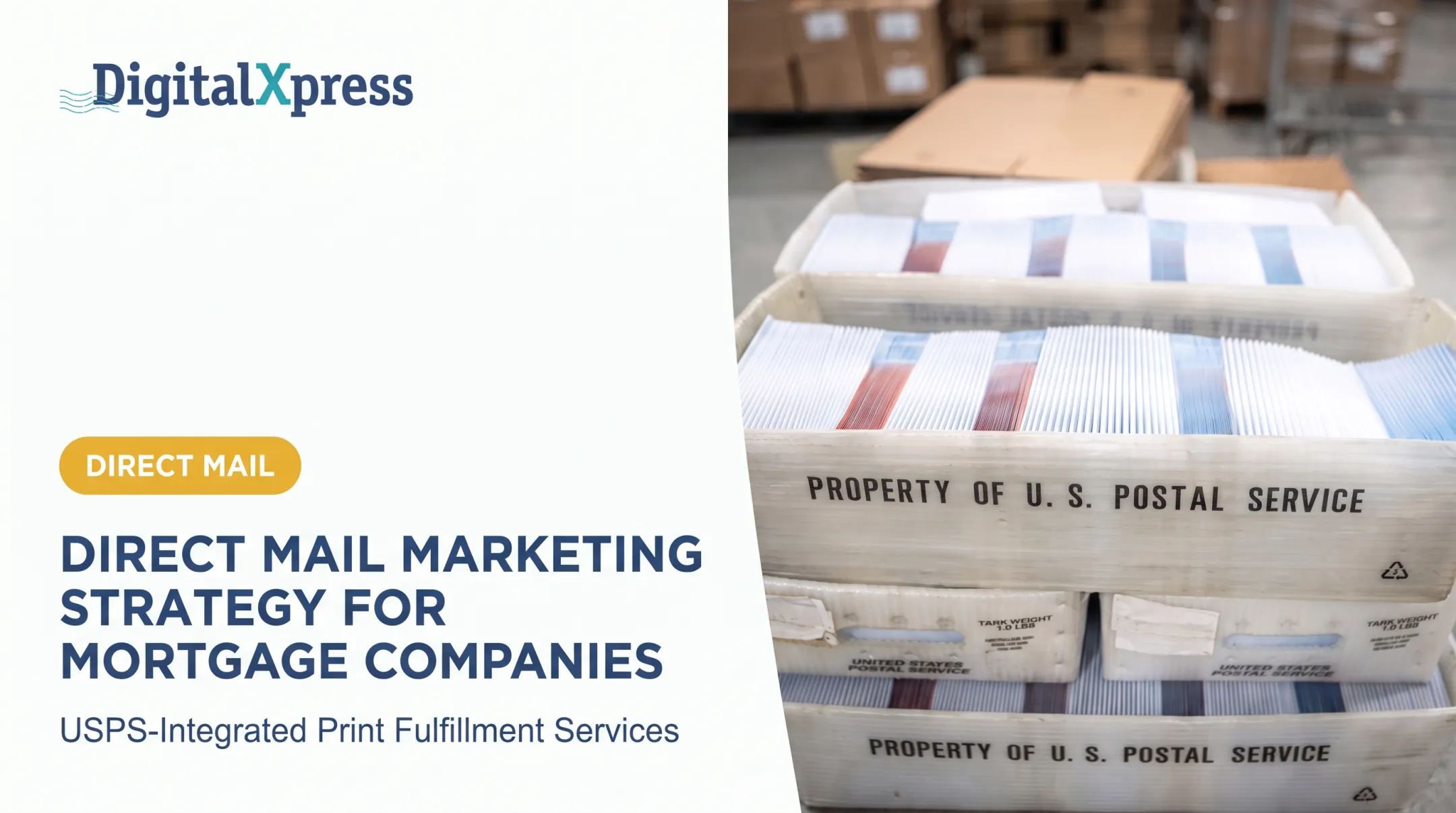
We run high-volume mail programs in-house (one recent campaign totaled 739,665 pieces across California and Nevada) with an on-site USPS Postal Clerk to move mail directly into the stream.
Build an Integrated Real Estate Marketing System
The strongest agent marketing doesn't treat each channel separately. One listing or market insight should generate an entire campaign:
- Build the core digital asset (listing page, market report, or virtual tour)
- Adapt it into email content and social posts
- Produce a matching flyer or brochure
- Drive local awareness with postcards and signage pointing back to the digital asset

Campaign Checklist
Before anything ships, run every asset through the same checklist:
- Consistent logo, colors, and fonts
- Accurate property details and required disclosures
- High-quality, current imagery
- One primary call to action
- A tested QR code or short URL
- A clear, working contact route
Templates for Speed, Custom Work for Impact
Reusable templates handle recurring needs like postcards and flyers efficiently. Save custom design and premium finishing (foil, spot color, or die cuts) for luxury listings, listing presentations, or brand campaigns where the extra investment pays off visually.
Measuring What Works
Track link clicks, QR-code scans, landing-page form completions, calls, and mailing responses. USPS recommends pairing each mail piece with a distinct QR code or personalized URL so digital activity connects back to a specific campaign. Avoid promising a fixed response rate; measure your own results and refine from there.
Build these habits into every campaign:
- Request FSC® Certified paper stock when sustainability matters to your brand
- Print only the quantities you'll realistically use
- Confirm your print and mail provider handles client data securely
We operate as an FSC® Certified facility (license #C112638) and maintain SOC 2® compliance for handling mailing data.
Bottom Line
More materials don't mean better marketing. The agents who stand out are the ones whose brochures, postcards, and websites reflect a consistent brand, speak to a specific audience, and make the next step obvious.
Start small with a focused core kit:
- Solid website
- Clean business cards
- One listing template
- One recurring print campaign
Expand from there based on property type, budget, and what the response data tells you.
If you're planning your next round of brochures, postcards, presentation folders, or signage, we handle creative design, printing, and mailing under one roof from our Albany facility. One vendor means less handoff risk across design, print, and mail.
Frequently Asked Questions
What are the best marketing materials for real estate agents?
A professional website, high-quality listing photography, business cards, a flyer or brochure template, direct mail, and signage cover most needs. The right mix depends on your audience and campaign goal.
What should be included in a real estate marketing package?
Include branded contact information, property or service details, professional imagery, and a clear value proposition. Add required disclosures, a call to action, and a link to a website or virtual tour.
Are print marketing materials still effective for real estate?
Yes. Print supports local visibility, in-person trust at open houses and listing presentations, and relationship marketing. It works best when the format matches the audience and pairs with a digital follow-up.
How can real estate agents connect print materials to digital marketing?
Add QR codes or short URLs to postcards and flyers that lead to a specific landing page, virtual tour, or email sign-up. Track scans and visits per campaign to see what's actually working.
What is the most important real estate marketing material for a new agent?
A professional website or profile, consistent business cards, and a strong listing presentation come first. From there, add manageable social content and a simple local outreach plan.
How often should real estate marketing materials be updated?
Review contact details, active listings, market data, and headshots regularly. Refresh QR code destinations, disclosures, and campaign offers any time information or branding changes.