Introduction
A marketing manager gets a request for 50,000 personalized mail pieces, due in three weeks. The office printer can't handle the volume. The finishing equipment doesn't exist.
And the mailing rules? Nobody on staff has touched a CASS-certified address list in years.
This scenario plays out constantly. Print jobs grow more complex, deadlines tighten, and internal teams often lack the equipment, staffing, or workflow infrastructure to keep pace.
Outsourcing printing offers a way through. Instead of buying presses, finishing equipment, and mailing systems you'll use a few times a year, you hire a partner who already has them.
This article covers what outsourcing actually includes, where it delivers real value, when it makes financial sense, and how to evaluate a provider before you sign a contract.
Key Takeaways
- Outsourcing covers printing, finishing, quality control, mailing, fulfillment, and delivery—not just ink on paper
- The lowest quote isn't always the lowest cost once labor, errors, and shipping are factored in
- Complex, high-volume, deadline-driven, or mail-based projects are the strongest outsourcing candidates
- Evaluate providers on security, quality, and turnaround, not price alone
What Is Outsource Printing?
Outsource printing means hiring an external commercial printer or print services provider to produce some or all of an organization's print jobs.
Taylor Corporation describes commercial print as high-quality materials for business, government, or institutional use, produced by specialized vendors on high-capacity equipment rather than desktop or office machines. Outsourcing means partnering with that vendor instead of maintaining an in-house print shop.
That's a different animal from managing an office copier fleet. Outsourcing project-based commercial printing means sending a specific job (a brochure run, a mailing, a trade show display) to an outside partner. Managing office printers internally, or through a managed print service, is an ongoing arrangement for everyday document output. This article focuses on the former.
The Typical Workflow
Most outsourced print jobs follow a similar path:
- Submit specifications and files — quantity, size, paper stock, color requirements
- Review proofs — digital or physical samples showing how the final piece will look
- Select materials and finishing — coatings, binding, die cuts, folding
- Approve production — sign off before the job runs
- Arrange delivery or mailing — pickup, shipping, or direct mail distribution

What Gets Outsourced
Businesses commonly send these projects to outside print partners:
- Brochures, booklets, and catalogs
- Manuals and annual reports
- Direct-mail pieces and postcards
- Newsletters and business stationery
- Posters, banners, and signage
- Trade show graphics and marketing kits
At Digital XPress, for example, we produce everything from small-run brochures to color-critical annual reports and personalized direct-mail campaigns exceeding 50,000 pieces. Each job runs on digital, sheet-fed offset, or web press equipment matched to its volume and quality needs.
Benefits of Outsourcing Print Jobs
The real payoff is what you stop owning, managing, and troubleshooting—not just handing the work to someone else.
Reduced Equipment and Labor Burden
Running print production in-house means owning presses, finishing equipment, and storage systems, then maintaining, upgrading, and eventually replacing all of it. In-house teams also carry ongoing costs for depreciation, servicing, supplies, and staff training that outsourcing removes.
Labor shifts with it. Specialists take on work such as:
- File prep and press operation
- Collating and packaging
- Shipping coordination
That frees internal staff for higher-value work.
Built-In Scalability
Internal print shops often hit a wall with:
- Large batch runs
- Seasonal volume surges
- Tight-deadline event work
An outside partner absorbs that surge without new equipment or seasonal hires. Siemens' RFP team made this call after internal output became too costly and labor-intensive to sustain, a case Mimeo has highlighted in its outsourcing guidance.
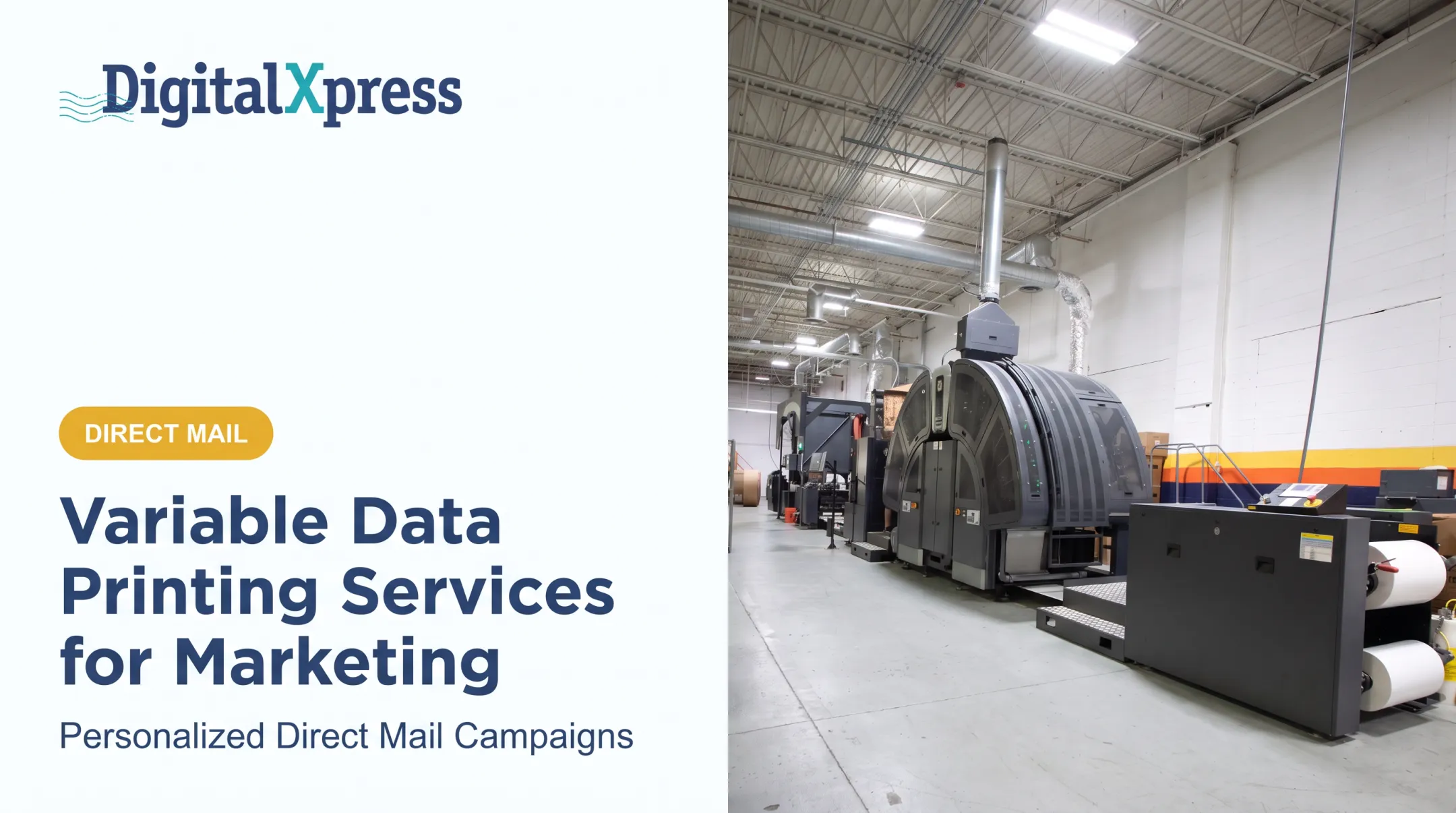
We run at that scale routinely. We completed 6,138 projects in 2025, averaging 511 per month, with presses running around the clock in peak periods. Our two HP T250 web presses have processed a combined 301 million feet of paper.

Consistency Across Locations
Professional prepress, color management, and quality-control processes matter most when a brand has multiple locations or frequent updates. A single production partner applies the same standards to every piece, whether it ships to one office or fifty.
Combining Print, Mail, and Fulfillment
Bundling printing with mailing and fulfillment through one provider cuts vendor juggling, especially on recurring campaigns.
Our largest single-project mail campaign totaled 739,665 pieces sent to California and Nevada. We also mail roughly 700,000 postcards weekly across client campaigns, with an on-site USPS Postal Clerk moving finished pieces directly into the mail stream.
When Should You Outsource a Print Job?
There's no universal volume threshold that triggers outsourcing. Instead, watch for these operational signals:
- Recurring high-volume work that strains internal equipment run after run
- Specialized finishing needs: die cuts, UV coatings, spot color, or metallic inks
- Large format production like banners, vehicle wraps, or trade show displays
- Tight deadlines paired with multiple project components due the same day
- Inconsistent internal output across locations or departments
- Limited internal capacity during seasonal spikes or major campaigns
Organizations with seasonal demand, multiple locations, or distributed mail recipients gain the most from external production that can flex with demand. A retail chain refreshing window graphics at twelve locations gets more consistency from one production partner than from coordinating twelve separate local shops.
When In-House Still Makes Sense
Outsourcing isn't the answer for everything:
- Same-hour jobs too small for external turnaround
- Sensitive prototypes that need immediate, hands-on iteration
- Routine office printing already covered by existing equipment
The practical middle ground: keep basic office printing internal, and outsource complex, branded, high-volume, mail-based, or installation-dependent projects. We build production around this hybrid model. Clients handle everyday printing in-house, then send annual reports, mail campaigns, or trade show materials externally.
Is Outsourcing Printing Cheaper?
Sometimes. It depends entirely on the job. There's no blanket answer, and any vendor who gives you one without asking questions first isn't being straight with you.
What to Actually Compare
In-house printing carries costs beyond the sticker price of a press:
| In-House Cost Factor | Outsourced Equivalent |
|---|---|
| Equipment purchase or lease | Included in per-project quote |
| Maintenance and servicing | Vendor's overhead, not yours |
| Paper, ink, and consumables | Bundled into materials cost |
| Operator time and training | Vendor's specialized staff |
| Storage and warehouse space | Often included or optional |
| Errors, waste, and reprints | Reduced through vendor QC processes |
| Shipping and postage | Can be optimized through vendor mail programs |
A print partner adds value through production expertise, efficient equipment, and consolidated vendor management. Confirm any claimed discount or incentive before you count on it, and don't assume advertised savings apply to your specific job.
Direct Mail Has Its Own Rules
If your project involves mail, postal requirements shape the real cost. USPS Marketing Mail requires a minimum of 200 pieces or 50 pounds per mailing — there's no single-piece rate for that class. First-Class Mail commercial pricing requires at least 500 pieces. Automation discounts require an Intelligent Mail barcode and a CASS-certified address list current within 180 days.

A provider with in-house mailing expertise can navigate these requirements in ways a general print shop or internal team often can't. Our team, for example, works with an on-site USPS Postal Clerk to pursue volume and sustainability-based discounts.
Your Cost-Comparison Checklist
Before comparing quotes, make sure both cover the same specs:
- Quantity and page count
- Size (flat vs. finished)
- Paper or substrate
- Color requirements
- Finishing (folding, binding, coating)
- Proofing process
- Packaging and delivery locations
- Postage and timeline
- Revision allowances and storage
Never compare two quotes with different assumptions. A quote that uses lighter paper, fewer finishing steps, or standard shipping instead of expedited delivery will always look cheaper, and it is not an apples-to-apples comparison.
Ask for a breakdown that separates production, finishing, mailing, shipping, storage, setup, and rush charges so you can see exactly what you're paying for.
How to Choose an Outsourced Printing Partner
Price matters. So does everything else on this list.
Match Capabilities to Your Actual Project Mix
Confirm the provider handles what you actually need: digital or offset printing, variable data, large format, binding, folding, die-cutting, inserting, or installation. A provider strong in short-run digital work isn't necessarily equipped for large format signage installation.
Demand a Real Proofing Process
A defined proof, sample approval, and correction procedure should cover color expectations, production updates, and errors caught after approval. Ask how each step works before you award the job. We require proofing on all digital and offset jobs and can provide a full-scale section proof for large format work on request before full production runs.
Verify Data Security Claims
If you're handling customer, healthcare, financial, or employee data, don't take "we're secure" at face value. Ask for:
- The actual SOC 2® report, scope, and audit period
- Access controls and secure file transfer methods
- Data retention policies
- Audit trail documentation
SOC 2® compliance reflects an independent audit of safeguards against unauthorized access, continuous monitoring, and accountability, not a marketing claim. We maintain SOC 2® compliance across our print and mail data handling.
Evaluate Mailing and Fulfillment Depth
If mail is part of the job, ask about address processing, presorting, inserting, inventory management, and delivery tracking. An on-site postal clerk (which we maintain) can move a project into the mail stream faster.
Distinguish Real Sustainability Credentials from Talk
FSC® chain-of-custody certification means forest-based materials are tracked through the supply chain and audited by accredited third parties. That is a verifiable control, not a general environmental slogan.
Ask for the certificate scope and the specific FSC® product claim, not just the logo. We are FSC® Certified and include sustainable paper options in standard quoting.
Confirm the Full Stack in One Partner
Based in Albany, NY, we combine these pieces for clients across the country:
- Over 35 years of production experience
- In-house print and creative services
- Large format capabilities with installation
- Integrated mailing support with an on-site USPS Postal Clerk
- FSC® certification and SOC 2® compliance
Use that mix as a checklist against any provider you evaluate. Not every print partner offers the same combination.
Conclusion
Outsourcing printing is a production strategy, not a bargain hunt. The strongest reasons go beyond price:
- Reduced operational burden
- Specialized expertise and scalable capacity
- Consistent quality across locations
- Integrated mailing that moves projects out faster
Start by inventorying your current print costs and workflow pain points. Then request a detailed proposal for your most complex, frequent, or resource-intensive jobs — the ones actually worth outsourcing.
If you're weighing a print, mail, creative, or large format project, contact us to talk through whether an outsourced workflow fits your needs.
Frequently Asked Questions
What is outsource printing?
Outsource printing means hiring an external provider to produce, finish, fulfill, mail, or deliver print materials instead of managing the entire process internally. It typically covers project-based work like brochures, direct mail, or signage.
Is it cheaper to outsource printing?
It can lower total costs, but the outcome depends on volume, specifications, internal labor, existing equipment, materials, shipping, and postage requirements. Compare full costs, not just per-piece quotes.
What types of print jobs should businesses outsource?
Complex, high-volume, branded, large format, deadline-sensitive, recurring, or mail-based projects are the strongest candidates. Routine office printing usually stays in-house.
What should I look for in an outsourced printing company?
Look for matching production capabilities, transparent pricing, a clear proofing process, verified security credentials, mailing and fulfillment support, and documented sustainability practices.
Can outsourced printing keep sensitive data secure?
Security depends entirely on the provider's actual controls and credentials, not general assurances. Ask for the specific SOC 2® report, access controls, secure file transfer methods, and data retention policies.