Saturation Mailing and Every Door Direct Mail (EDDM) both let organizations blanket a geographic area through the postal service. But they differ in how much control you keep, how much prep work is required, and what the campaign actually costs once printing, addressing, and postage are added together.
That distinction matters. The wrong choice can mean paying for coverage you don't need, or missing the ability to exclude addresses that will never convert. Sixty-six percent of consumers say they engaged with or acted on direct mail they received, according to a March 2022 National Postal Forum survey cited in a USPS EDDM fulfillment kit. That's a strong case for direct mail generally, but it says nothing about which format is right for your budget or audience.
Before picking a lane, weigh your campaign goal, route coverage, audience criteria, format needs, budget, timing, and how you'll measure results.
Key Takeaways
- EDDM is simpler and route-based; Saturation Mailing adds addressing, suppression, and format control.
- Lowest postage rarely equals lowest total cost once printing, list prep, permits, and handling are included.
- Choose EDDM for broad route-based awareness; choose Saturation Mailing for exclusions or repeat campaigns.
- Always confirm current USPS eligibility rules, dimensions, and rates before production begins.
Saturation Mailing vs. EDDM: Quick Comparison
Cost
Saturation Mailing postage can qualify for USPS Marketing Mail's ECR Saturation pricing tier, which typically runs lower than standard carrier-route rates. But postage is only one line item. You'll also budget for:
- List or address data preparation and suppression
- Mailpiece design and production
- Permit fees and mail entry logistics
- Handling, sorting, and delivery documentation
EDDM removes the mailing-list requirement, which cuts setup time and cost. However, EDDM's larger flat-size requirements can push print costs higher per piece than a standard letter-sized mailer.
Mailing List and Addressing
Saturation Mailing may use a provider-managed or customer-supplied list, with addressing options ranging from generic ("Postal Customer") to named recipients, depending on the campaign's structure.
EDDM skips the list entirely. Routes are selected through USPS mapping tools, and mail reaches every active address on that route.
Targeting and Suppression
Who receives the piece is the clearest split between the two programs:
- Saturation Mailing allows route selection plus filtering or suppression of specific addresses, when campaign rules and density requirements permit it.
- EDDM targets by geography only. Once you pick a route, every address on it gets mail. There's no household-level exclusion.
Mailpiece Formats and Personalization
Saturation Mailing under USPS Marketing Mail supports a wider range of formats, including letters, flats, and variable content with personalized addressing.
EDDM is built around standardized flats, postcards, and brochures, with size and weight limits that make personalization more limited. Confirm current USPS specifications before finalizing your design.
Operational Complexity and Best Fit
- Saturation Mailing fits recurring, high-volume, or moderately filtered campaigns where the extra prep work pays off.
- EDDM fits organizations that want broad reach without building a mailing list from scratch.
What Is Saturation Mailing?
Saturation Mailing is a USPS Marketing Mail approach designed to reach a high percentage of deliverable addresses within a selected carrier route, in exchange for discounted postage.
According to USPS Postal Explorer, the mailing must reach at least 90% of total active residential deliveries, or at least 75% of total active deliveries, on each route it touches. If a simplified address format is used instead, that threshold rises to 100%.
Saturation Mailing remains a broad-reach channel rather than true one-to-one targeting. Compared with EDDM, it offers more flexibility through partial filtering or suppression when campaign rules allow.
What to Verify Before Production
- Applicable mail class and permit requirements
- Addressing method (generic, occupant, or named)
- Route coverage and presort sequence (USPS requires walk-sequence prep)
- List hygiene, address quality, and required postage documentation
Cost Beyond Postage
Total cost includes printing, data preparation, address verification, suppression work, sorting, creative versioning, and any provider or permit fees.
Our 2024 USPS Marketing Mail rate guide lists ECR Saturation postage at $0.229 per letter under 3.5 ounces and $0.305 per flat under 4 ounces. Confirm current rates against the USPS Notice 123 price list before you commit to a mail date.

Where Saturation Mailing Fits
Because it allows some suppression, Saturation Mailing works well when broad geographic demand exists but not every address is equally valuable. Common applications include:
- Home services, utilities, and financial outreach
- Nonprofit appeals, membership renewals, and event promotion
- Healthcare communications and multi-location retail promotions
Nonprofits in particular use route-based saturation campaigns for renewals and newsletters while suppressing existing donors or members from the broader mailing, keeping messaging relevant without duplicating outreach to people already engaged.
What Is EDDM?
Every Door Direct Mail lets you select carrier routes through USPS mapping tools and distribute an eligible mailpiece across those routes, without building an individual recipient list. That single feature, no mailing list required, is what makes it attractive to first-time or small-business mailers.
Retail vs. BMEU
EDDM comes in two entry options:
- EDDM Retail: For local businesses mailing about 200 to 5,000 pieces per day per ZIP, per the USPS EDDM service page. No special permit; drop at a local Post Office.
- EDDM BMEU: For volumes above 5,000 pieces per day. Requires an active USPS Marketing Mail permit and entry at a Business Mail Entry Unit.
Route Selection and Mailpiece Limits
You review route geography, estimated household coverage, and proximity to your business using USPS tools. Mailpiece specs still control eligibility.
EDDM Retail pieces must be flats that:
- Weigh no more than 3.3 ounces
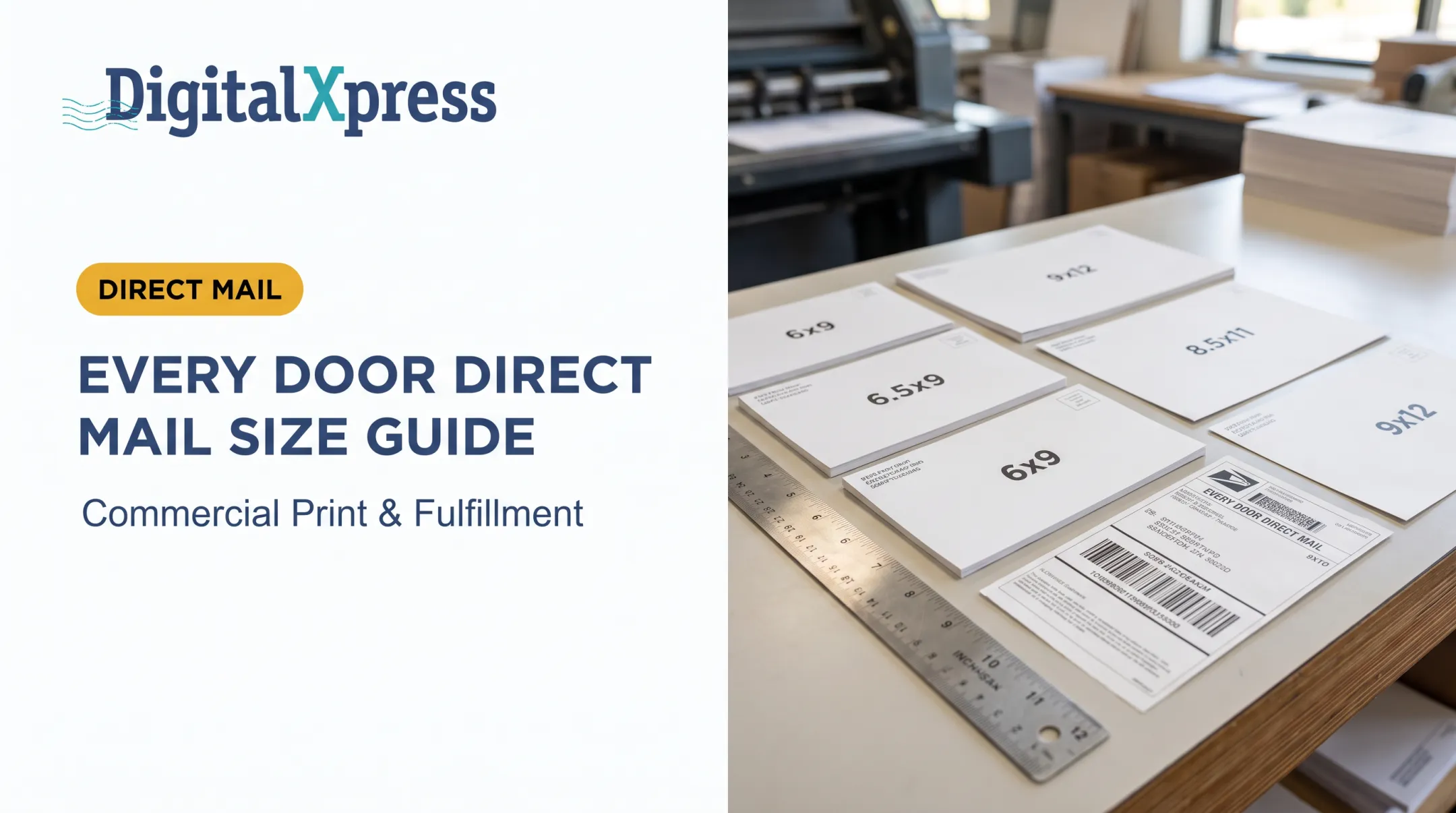
- Meet at least one size threshold: over 10-1/2 inches long, over 6-1/8 inches high, or over 1/4 inch thick
Verify current dimensions against USPS's official size checker before printing, since specs change.
Where EDDM Fits
EDDM works best for campaigns with broad local appeal where nearly every household is a plausible customer:
- Grand openings and seasonal retail offers
- Restaurant promotions and community events
- Home-service awareness campaigns
- Political, civic, or area-wide nonprofit outreach
The tradeoff: EDDM can't identify or exclude individual households within a route. It fits offers relevant to most people in that geography, not niche audiences.

Saturation Mailing vs. EDDM: What Is Better?
Neither option is universally "better." The right choice depends on six factors: campaign objective, desired coverage, audience control, mailpiece format, setup resources, and how you plan to measure results.
Choose EDDM when:
- You want simple, broad geographic coverage
- Your offer appeals to most households on the route
- You don't have a usable mailing list
- A standardized flat or postcard fits your creative
Choose Saturation Mailing when:
- You need to suppress specific addresses
- The campaign will repeat across multiple mail dates
- You want more format or addressing flexibility
- You need better control over which residential or business segments receive the piece
Neither fits when your audience is defined by customer attributes rather than geography—income bracket, purchase history, profession, or business type. That calls for a targeted mailing list, not route selection.
Pre-Launch Checklist
- Define your objective and the specific conversion event you're measuring
- Estimate route coverage and how many households or businesses you'll reach
- Calculate total cost: printing, prep, postage, permits, and handling
- Confirm current USPS eligibility rules for your chosen format
- Lock in your creative format and offer
- Build tracking into the piece: unique codes, QR codes, or dedicated phone lines
- Set a follow-up timeline for repeat mailings or retargeting
We work through these tradeoffs with clients directly—creative, print, mailing prep, and fulfillment stay in one in-house workflow.
An on-site USPS Postal Clerk approves mail before it leaves the building, and SOC 2®-compliant handling covers campaigns with sensitive recipient data. Fewer handoffs between design and delivery keep timelines tighter.
Real-World Examples
An EDDM case in a USPS small business brochure covers Cochiaro Pizza in Northlake, Illinois. The shop sent oversized EDDM postcards with coupons and reported a 12% boost in business. No mailing list, no suppression—just route selection and a relevant local offer.
On the Saturation Mailing side, Mail Shark's case study on Five Star Pizza, a Florida franchisee, shows a longer play. The chain ran a 52-week saturation program—250,105 pieces across five campaigns at $78,907.
Results included a 12% weekly sales increase, a 5.99% coupon redemption rate, roughly 3,000 new customers, and a reported 299% ROI based on average order value. That recurring, higher-investment pattern is where Saturation Mailing's repeatability pays off.

The takeaway: broad, one-time neighborhood awareness points toward EDDM. A recurring or moderately filtered route campaign more often justifies Saturation Mailing's added prep work.
Weigh route strategy against total campaign cost before you lock a format. Our direct mail team can walk through mailpiece options, prep requirements, and a full cost breakdown for your campaign.
Conclusion
EDDM is usually the simpler path when you want broad, route-based awareness without building a list. Saturation Mailing earns its extra preparation when you need suppression, repeatability, or more control over formats and addressing.
Either way, judge the full campaign—not postage rates alone:
- Total campaign cost
- Current USPS requirements
- Audience fit
- Creative format
- Measurement plans
At Digital XPress, we have run print and mail projects in-house for over 35 years, including campaigns topping 700,000 postcards a week. Our team can help you choose which approach fits your next mailing.
Frequently Asked Questions
How much does marketing mail cost?
Cost depends on postage, quantity, mailpiece size and weight, printing, list or route preparation, permits, and fulfillment services. Request a project-specific estimate rather than relying on a general figure, since USPS rates and specs change.
What is the success rate of direct mail marketing?
Success varies by audience, offer, creative, coverage, timing, and follow-up. Measure results with unique codes, dedicated URLs, QR codes, or call tracking rather than relying on industry averages alone.
What are the key differences between saturation mailing and EDDM?
EDDM is strictly route-based with no mailing list required, while saturation mailing allows more addressing, suppression, and format flexibility. Verify current USPS eligibility rules for each campaign before production.
What is a saturation mailing?
A high-coverage mailing that reaches most eligible addresses on a selected route or area and generally meets USPS density requirements for discounted postage. It is broader than individually targeted mail but still allows some filtering.
Is EDDM cheaper than saturation mailing?
It depends on total campaign cost, not postage alone. Compare printing, preparation, list management, permits, format, and handling before assuming one option is less expensive.
When should I use EDDM instead of saturation mailing?
Use EDDM when you need simple, broad geographic reach, your offer suits most households on the route, and you don't need individual suppression or advanced personalization.